Written by JCAFA
The Chuditch (Djooditj, Dasyurus geoffroii) is Western Australia’s largest carnivorous marsupial. Once inhabiting 70% of the Australian mainland, it is now largely restricted to the state’s southwest. Its presence in the Julimar State Forest represents a significant conservation success story.
Identified by its white-spotted brown fur and black-tipped “brush” tail, the Chuditch is a solitary, nocturnal hunter. A carnivore, its diet consists of large insects, small mammals, birds, and lizards.
Their spatial requirements are significant. While females occupy stable territories of 3-4 km2, males can roam across ranges up to 15 km2. Currently listed as Vulnerable, the species is a high priority under the Federal Threatened Species Action Plan. Because its survival depends on a functional food chain, it is widely considered a key indicator of environmental health (Morris, K. (1992). Return of the Chuditch. Landscope).
Julimar Forest’s Wandoo and Jarrah woodlands provide the hollow logs and burrows essential for nesting. Following a period of decline due to habitat loss and predation by foxes and feral cats, the Department of Conservation and Land Management (now DBCA) released 23 Chuditch into the forest in 1992.
By 2017, monitoring by DBCA confirmed that Julimar was home to one of the healthiest Chuditch populations in Western Australia. This colony now serves as a “source” for translocation programs to increase genetic diversity and establish new populations. Healthy individuals from Julimar have been successfully relocated to: Shark Bay and Alice Springs (2012); The Flinders Ranges, South Australia (2017); and Mt. Gibson Sanctuary (Australian Wildlife Sanctuary, 2023).
Strategically located near Toodyay and Bindoon, Julimar acts as a vital bridge between northern and southern Darling Range populations. While these nocturnal creatures are rarely seen by visitors, they are frequently captured on our trail cameras. Locally, they are known to visit private properties abutting the forest, exploring sheds and bushland.
Djooditj – Guardian of the Night
By Noongar Kaartdijin Aboriginal Corporation of Dudjabup (Toodyay)
The Chuditch – known as Djooditj in Noongar – is one of the quiet voices of the understory.
Djooditj moves like shadow – fierce, quiet, and clever.
This sharp-eyed hunter teaches us the value of observation and the strength found in silence.
Long before roads, machinery, and burn plans, the Djooditj moved through these woodlands among fallen timber, leaf litter, dense shrubs, and the rich life of the forest floor.
Its survival depends not simply on trees remaining standing, but on the health, shelter, and complexity of the entire ecosystem beneath them.
The forest floor itself is alive with countless small workers – fungi, insects, reptiles, mammals, microbes, and soil-engineering species – all quietly recycling vegetation into life, moisture, shelter, and health.
These hidden systems help forests retain balance and resilience over time.
For Noongar people, animals like the Djooditj are part of the living fabric of Country – not separate from boodja, but deeply connected to it.
When these animals struggle or disappear, Country is telling us something.
Perhaps the Djooditj asks us to see the forest differently – not simply as fuel to be managed, but as a living community of relationships that has evolved over thousands of generations.
Protecting places like Julimar is not only about saving a species. It is about listening to the quieter voices of the forest before they are lost altogether.
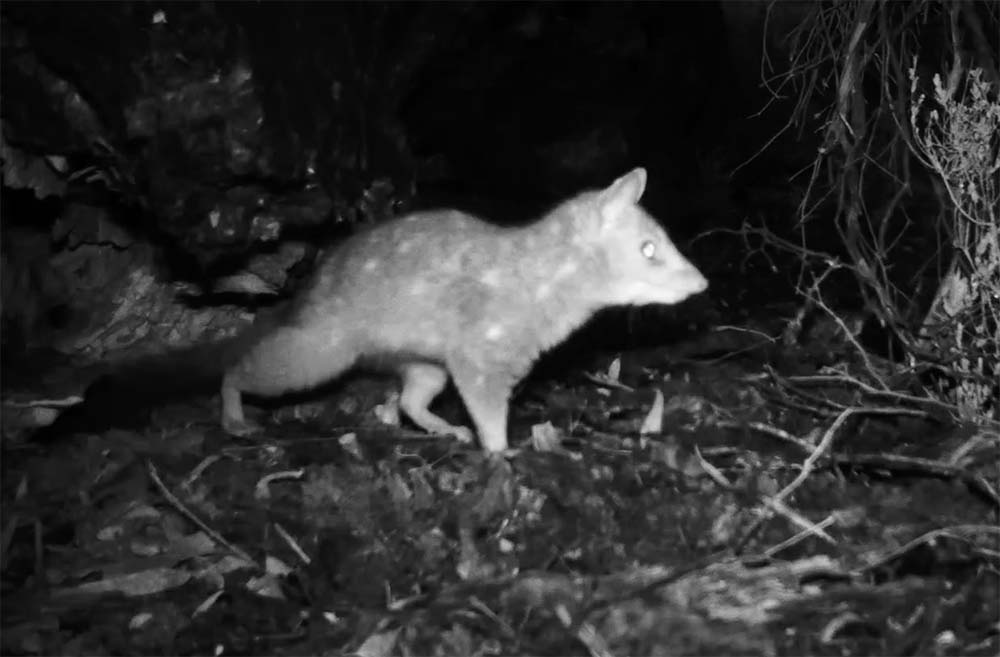
A Chuditch caught on camera in Julimar State Forest