Written by Melissa Adams, JCAFA
Original Article: April 2026 edition of the Toodyay Herald.
Due to rain, we had to postpone a popular Native Bee survey in Julimar State Forest at our September BioBlitz last year, led by ecologist, Dr Kit Prendergast.
We were relieved when Dr Kit said she was keen to come back in October, supported by the Conservation Council of WA, to continue the survey.
This time, despite limited wildflowers, Dr Kit and our team of volunteers still documented four species in three genera (Leioproctus, Lasioglossum and Lipotriches) in the vicinity of Heine Road.
“Given the high seasonal turnover in species abundance and diversity recorded over the spring and summer in other parts of SWWA (Swan Coastal Plain, Jarrah forest), it is likely that this is just a small snapshot of the diversity of native bees at Julimar,” Dr Kit explained.
When a lot of people normally think of bees, they tend to picture the introduced honeybee. But, if you look more closely at the insects in your garden, or while walking in the bush, you’ll likely start to recognise other bees pollinating the flowers; cutting leaves with their mandible (Leafcutter Bees); building nests in small holes in wood (eg. Leafcutter Bees, Resin Bees) or in dirt or clay (eg. Blue-banded Bees); or building hives, producing honey (Stingless Bees). They range in size from just a few millimetres to the size of your thumb.
Australia has a huge variety of native bees, and they are a vital part of our natural world. Some native species are pollinators, while others have special relationships with native flora. Like many insects, they are bioindicators of healthy ecosystems, providing insights into environmental change or land clearing.
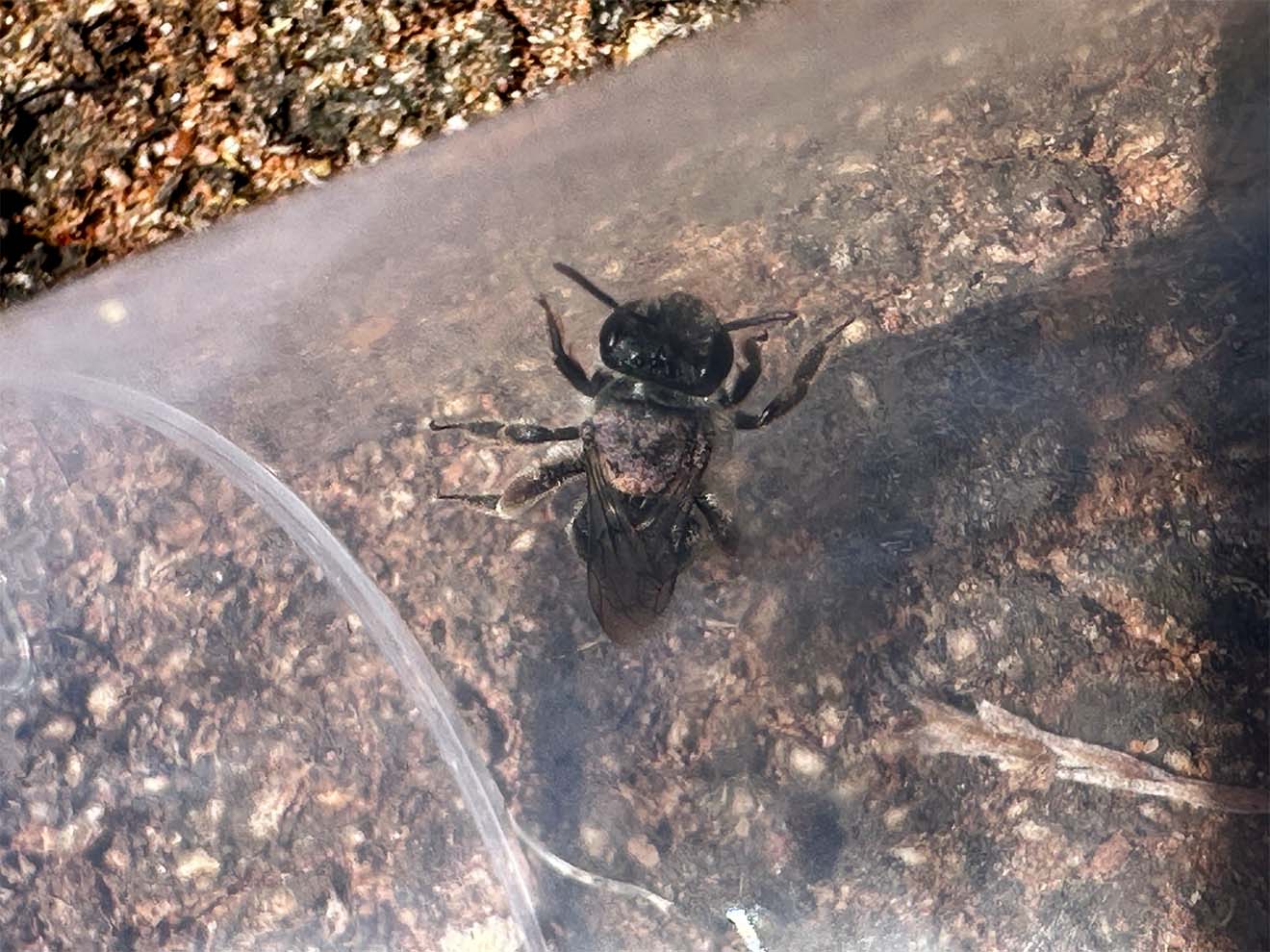
Insects overall are on the decline. A 2024 study estimates that 9000 insects and other native invertebrates have become extinct in Australia since European arrival, and between 1 and 3 additional species become extinct every week.
Cleared habitat and the use of harmful pesticides are drivers of this decline. Climate change also impacts insects by altering temperature and moisture conditions, which can disrupt their seasonal life cycles.
According to Dr Kit, there is a lot we don’t know about native bees: “There exist large knowledge gaps about their diversity, distribution, plant interactions, and phenology. There are over 1,700 described species, yet we estimate there are at least 500 undescribed species.” This is why surveys, like the one conducted in Julimar State Forest, are so important. If we don’t close the knowledge gap, there may be bees that become extinct before even being identified.
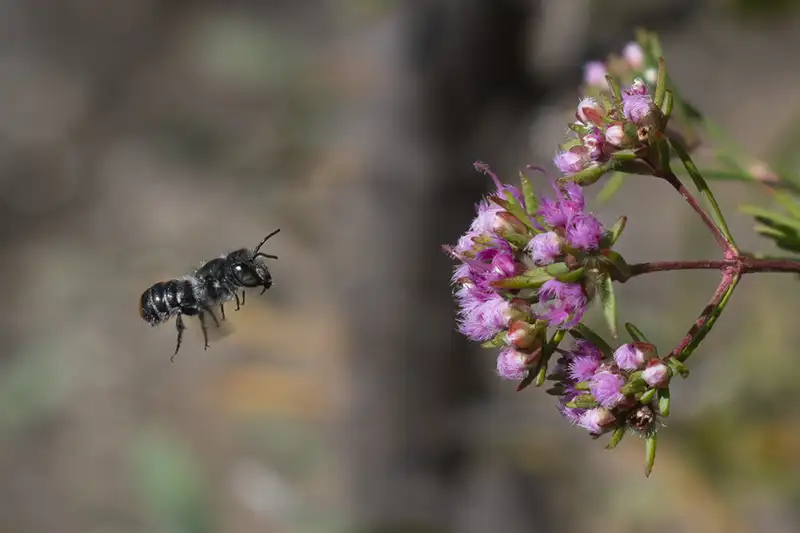
Native Megachile bee approaching the flowers of the Painted Featherflower (Verticordia picta).
Photo by Melissa Adams.
So, what can you do as an individual to help conserve these wonderful insects?
- Attend surveys or perform your own by uploading your sightings to iNaturalist (the more we know, the better protection we can advocate and provide)
- Raise awareness about native bees
- Plant native flowers, especially in the families Fabaceae and Myrtaceae
- Protect and restore native habitat
- Reduce harmful pesticide use
- Provide nesting habitat in your backyard and make well-designed bee hotels
- Follow experts like Dr Kit on social media, and learn more about these fabulous creatures (Kit’s Facebook page/Kit’s Facebook group)
We will be conducting more native bee surveys in Julimar State Forest toward the end of 2026. As Kit says, “More discoveries await,” and we can’t wait to see what we find next.
Email us to register your interest in being part of future surveys, including birds, plants, and other species, at julimarforest@gmail.com or follow us on Facebook. You can also join the iNaturalist project to record your sightings.