
Written by JCAFA
Original Article: May 2026 edition of the Toodyay Herald.
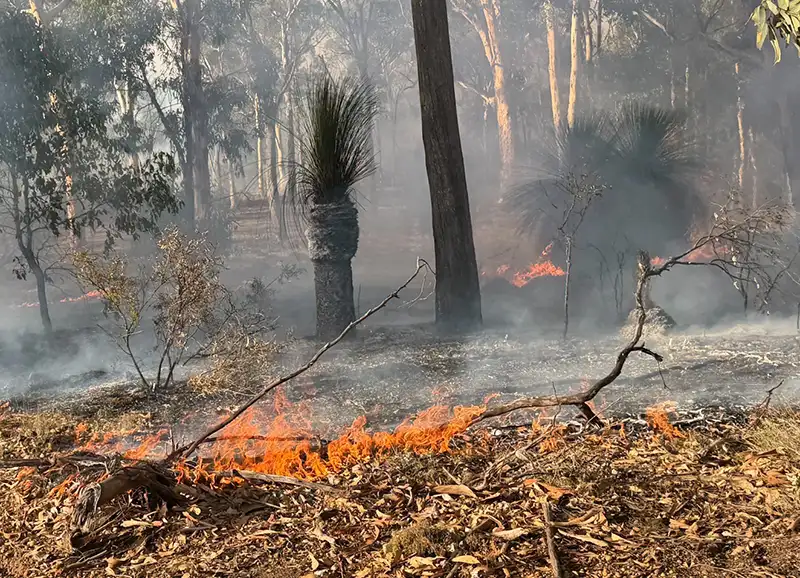
It’s a familiar phrase across Australia: “our bush needs fire to survive.” But not all scientists agree. With controlled burns carried out across large parts of Julimar State Forest over the past week, it is a timely moment to take a closer look at that assumption.
A body of research, including work by Albany-based botanist Professor Stephen Hopper, suggests we should be cautious about viewing fire as the dominant evolutionary driver of Australian plants. Over more than 50 years in conservation biology, including leadership roles at Kings Park in Perth and the Royal Botanic Gardens, Kew, his work has challenged long-held ideas. In particular, he argues that the evidence linking fire to the evolution of many plant traits is less clear than commonly believed.
Many features of Australian plants are often cited as proof that our ecosystems evolved with fire. These include regeneration from seed banks, post fire flowering, hard protective seed coats, smoke triggered germination, and even the flammability of plant material itself.
At first glance, these traits appear well suited to surviving fire. However, an important distinction is often overlooked: just because a trait helps plants persist after fire today does not mean it evolved because of fire, or that it depends on fire to persist.
Professor Hopper and other botanists warn that it is easy to confuse present-day observations with long-term evolutionary processes. In simple terms, correlation is not causation. A familiar analogy is the idea that shark attacks increase with ice cream sales. Both rise in summer, but one does not cause the other, warmer weather drives both.
The same caution applies to plant traits. Resprouting, for example, is often described as a fire adaptation. Yet similar regrowth strategies occur in response to drought, frost, grazing, flooding and wind damage. Fire is only one of many environmental pressures that can favour this kind of resilience.
Scientists distinguish between adaptation, where a trait evolves for its current role, and exaptation, where a trait evolves for one purpose but later proves useful for another. This distinction is key when interpreting plant characteristics.
Take sclerophylly, the tough, fibrous leaves common in many native species such as eucalypts and wattles. These are often described as adaptations to fire or dry conditions. However, fossil evidence shows such leaves existed 50 to 60 million years ago, when Australia was much wetter. A likely explanation is that they evolved in response to nutrient-poor soils, with fire tolerance emerging later.
So, does the bush “need” fire? Some species may benefit from it, but the broader picture is more complex. As surveys begin at Julimar, there is an opportunity to move beyond slogans and towards a more careful, evidence-based understanding of how our landscapes function and how best to manage them.