Current Concerns
The Threat of Industrial Mining
Chalice Mining’s proposed Gonneville Project is the biggest threat to Julimar State Forest. This project, located on the forest’s doorstep, risks irreversible damage to the environment and the health of our local communities.
More reading:
- Chuditch program in danger if proposed mine goes ahead
- Will Chalice Mine Leave An Unwanted Legacy?
- Asbestos, air quality, water pollution: Gonneville to be subject to a Public Environmental Review
- The Ponds of Doom
- The global race is on to secure critical minerals. Why do they matter so much? (The Conversation)
- Mining survey reveals deepening community concern
Julimar State Forest is part of the Northern Jarrah Forest region, a 250 km long ecosystem stretching from Toodyay to Collie, which is facing collapse due to climate change and mining-related deforestation.
Mining in forests has devastating consequences for the delicate ecological balance that has developed over time. The impact extends across multiple factors, including:
- The physical, chemical, and biological composition of the soil,
- Surface and sub-surface water availability and flow,
- The intricate relationships between flora, fauna, and the micro-climates they create.
In most scenarios, mining amounts to deforestation, with serious degradation of the forest surroundings. Western Australian forests are particularly vulnerable due to the state’s legal framework, which prioritises mining over other land use.
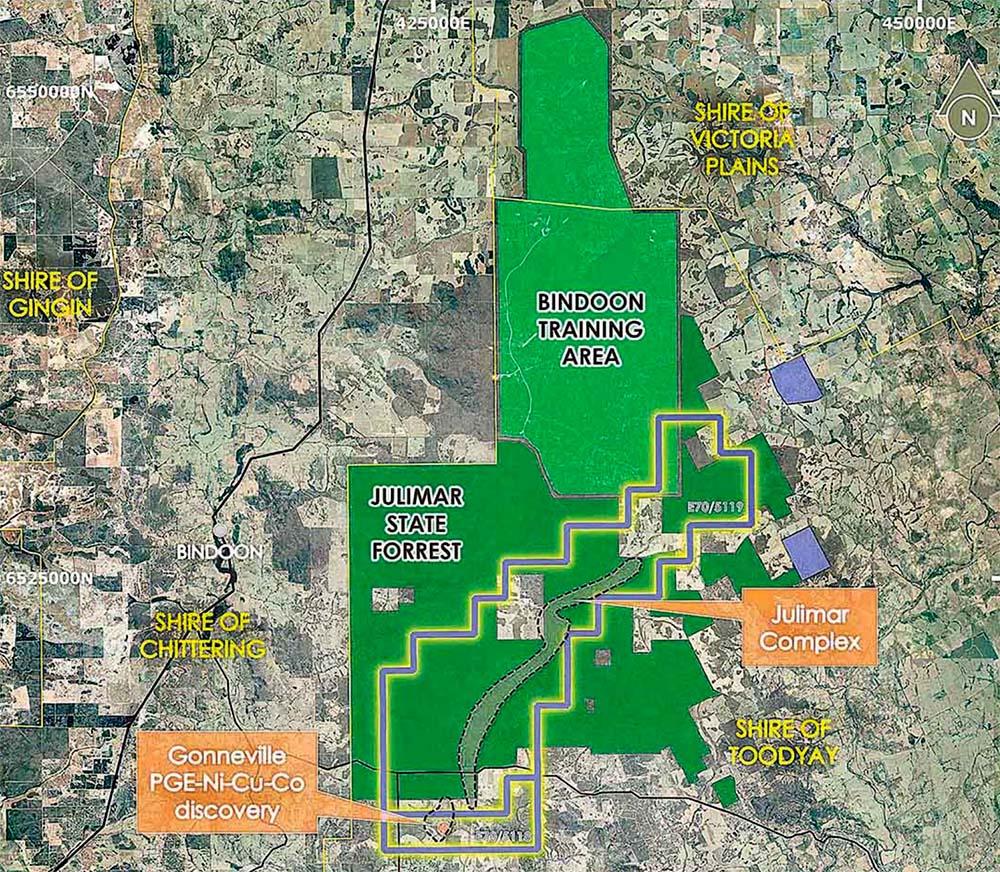
The Gonneville Project, a large-scale critical minerals mining development located adjacent to Julimar State Forest’s southern border, is an immediate threat to the Forest. The deposit contains critical minerals essential for electric vehicles, renewable energy systems, and other clean energy technologies.
Currently (as of March 2025), Chalice Mining is conducting a feasibility study for the first phase of the project, which includes an environmental assessment through a Public Environmental Review (PER) overseen by the Environmental Protection Authority (EPA). [View EPBC Project]
The initial mining operation will be an open-pit mine. Chalice has conducted exploration drilling in Julimar State Forest, indicating plans for potential expansion into this ecologically sensitive area. The project is focused on a geological formation known as the ‘Julimar Complex’, spanning over 30 kilometres through the Forest.
We ask that when the status of National Park is given, Julimar State Forest should be exempt from mining, and all existing mining tenements be terminated and future applications refused.
Ecological and Environmental Impact
Julimar State Forest is part of a 68,300 ha bushland corridor, connecting the Bindoon Training Area in the north to the Walyunga National Park in the south. The proposed clearing of 940 ha of vegetation for the Gonneville Project threatens this critical green corridor, disrupting wildlife migration, an issue that is particularly concerning in the face of climate change.
The mine’s hydrological disruption, continuous noise, dust, and artificial lighting could interfere with breeding cycles and force wildlife into unsuitable habitats, increasing the risk of species decline and extinction.
Threats to Water Resources
A major concern is the potential impact on the Avon and Brockman River catchments, which are essential water sources for local ecosystems and communities. These catchments feed into the Swan River system, which plays a vital role in the health of the broader region.
The geology of the Gonneville site presents serious risks of acid mine drainage, a long-term environmental hazard that generates sulfuric acid. This acidic runoff can contaminate local aquifers and surface water for decades, making water pollution one of the project’s most pressing concerns.
Sealing tailings dams (used to store mining waste) and waste rock dumps will be exceptionally challenging due to the geological conditions. If acid mine drainage occurs, preventing it from spreading into surrounding water systems will require extensive and ongoing environmental management.
Additional Environmental Risks
- Air and Water Pollution – The project’s mining processes could introduce harmful particulates and chemicals into the air and water. Dust rich in silica poses a long-term risk of chronic lung issues like silicosis. Preliminary geological data indicate potential asbestos in the ore body, creating serious airborne and waterborne pollution risks that demand strict environmental controls.
- Tailings Dams and Wildlife Risks – Mining waste ponds can look like natural water bodies, which, unfortunately, attract wildlife and have caused documented mass bird deaths in Australia.
Impact of the infrastructure corridor
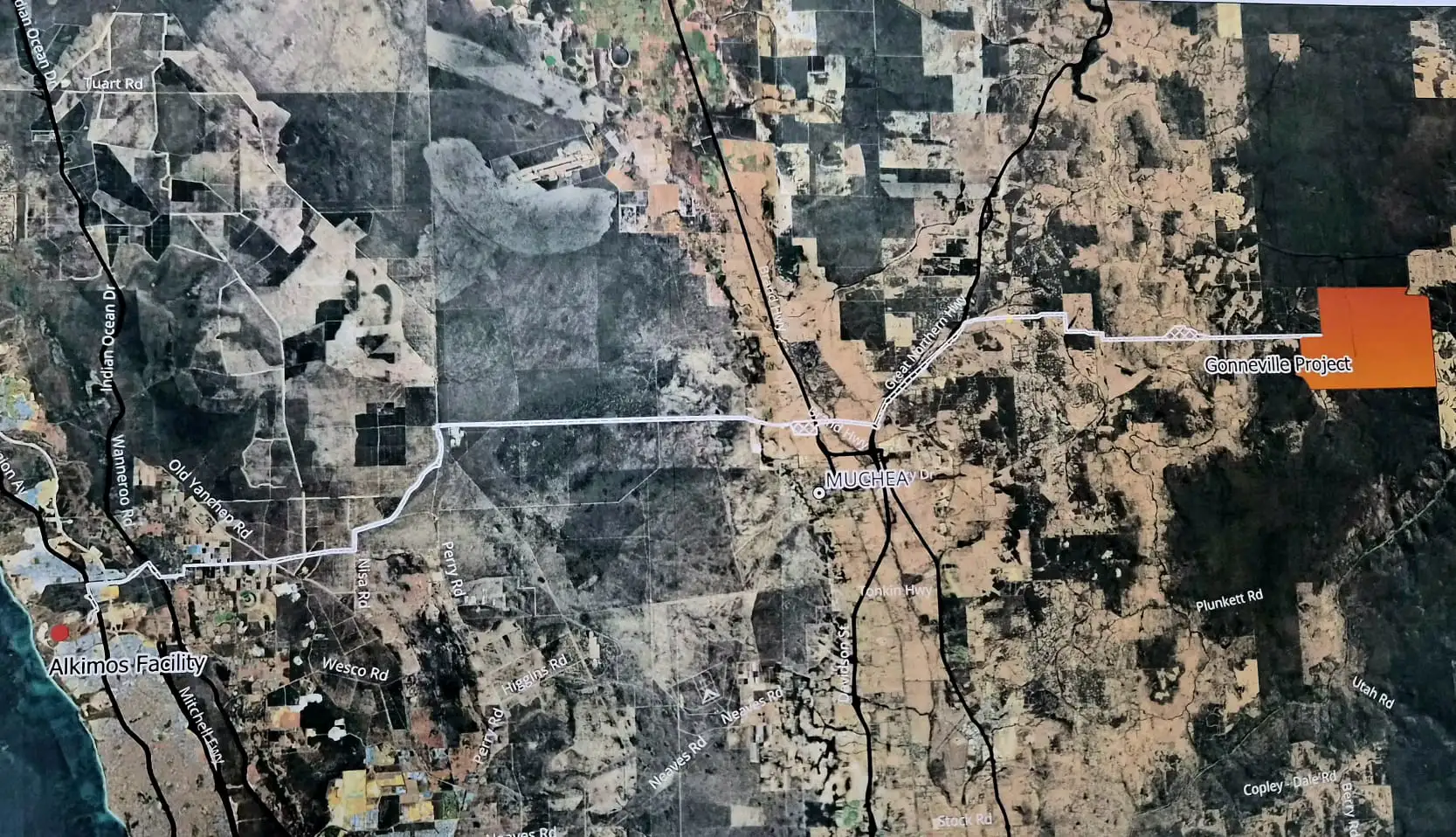
In May 2026, several Chittering residents received notices that the water pipeline and power infrastructure could traverse right through their private properties as part of the project.
The proposed corridor has the potential to affect numerous rural and rural residential properties. The full extent of impacted landholders remains unclear because a detailed corridor alignment has not been publicly released.
Understandably, local landowners are deeply concerned about the prospect of a mining corridor cutting directly through their land. Proximity to homes, wildlife habitat, and rural-residential communities are raising serious questions.
Some of these blocks are currently under strict Shire covenants and are legally restricted from clearing trees within these designated preservation areas. It seems a tad ironic that a mining company can have license to clear those protected trees.
This proposed corridor would also directly affect a land-titled Tree Preservation Area, home to recorded Carnaby’s Black Cockatoo hollows and vital native vegetation.
Below, you’ll find a map of the corridor provided by the Chittering group, formed as a result of this collective concern. As a formal map has not been supplied, this has been created based on what has been gleaned by the residents.
The destruction of critical habitats, the contamination of water resources, and the disruption of local ecosystems and economies make it clear that the true cost of this project will be borne by the environment and the people of the region.
What can you do?
TAKE ACTION: Demand Oversight on Mining
We are demanding that regulators and decision-makers recognise the true significance of these environmental and health risks.
Sign the 'Community Declaration of Opposition to the Proposed Gonneville Mine'
Prescribed Burning

- May 2026 prescribed burns update
- Does prescribed burning need a rethink?
- To Burn, or Not to Burn A Critical Perspective – Emeritus Professor Don Bradshaw
- Decolonising Fire Science – Dr Philip Zylstra
- Research Gate: Dr Philip Zylstra
- Analysing the Wildlife Toll of Prescribed Burning Practices in Southwest WA
Update May 2026:
Please refer to our article “2026 prescribed burns update”.
—
There are currently two proposed prescribed burns in the Julimar State Forest, covering a combined area of 7528 hectares, which is 26% of the whole forest!
Part of the burn plan has already been conducted. The remaining burns will be conducted in Autumn 2026.
We have identified several critical inaccuracies and significant concerns within the high-level burn plans that must be addressed before DBCA proceeds with the burns. We are currently in conversation with them.
The planned use of aerial ignition is deeply concerning. This method is devastating to ground-dwelling fauna because it leaves few unburnt refuges for them to escape to, reduces food sources, and drastically reduces habitat quality.
Failure to Prevent Bushfires: Experts argue that frequent burning does not effectively inhibit major bushfires. Instead, it can make the forest more flammable in the short term.
Escaped Burn History: The risk of the fire becoming harder to control and escaping as a damaging bushfire is high. Several prescribed burns in southwest WA have escaped control, including the incident at the Weinup block near Perup Reserve in 2021. This was an extremely hot burn, ignited by aerial incendiaries dropped from a helicopter. It devastated the numbats’ habitat, destroying approximately 5,000 habitat trees and completely consuming the fallen logs that house their termite food source. Consequently, any numbats that survived the fire were left without food, cover, or protection from predators.
Ecological Decimation: Prescribed burns risk the decimation of vital ecosystems like the Wandoo Woodland. This destruction severely harms vulnerable native fauna, including the Chuditch and the Woylie, by removing their protective cover and making them susceptible to predators. Furthermore, these fires destroy essential foraging plants needed by species like the Black Cockatoo. A clear warning comes from the previous aerial-ignited fire in Weinup, which destroyed approximately 5,000 habitat trees and completely consumed the fallen logs that house numbat’s termite food source. Consequently, any numbats that survived the fire were left without food, cover, or protection from predators.
The Solution: Safe, Targeted Strategies
Ideally, we request that dangerous aerial burns be removed from the program entirely in favour of alternative, less destructive land management strategies, like rapid bushfire suppression technologies, that protect the Forest and the community.
We ask DBCA to:
- Suspend the burn plans immediately to allow for a full community consultation and a comprehensive reassessment.
- Significantly reduce the size of the proposed burns.
- Commit to not using aerial ignition methods.
- Accurately reflect the level of contention within the community.
- Recount all nest boxes within the burn sites.
- Rewrite the burn plan to accurately describe the forest’s conservation value and address the factual errors we have identified.
More broadly, we would like to see:
- An in-depth independent study into the biodiversity and animal welfare impacts of current prescribed burning methodologies.
- More consultation with Traditional Owners regarding fire management, incorporating their time-proven traditional knowledge.
- Inappropriate prescribed burning targets abolished (e.g., KPIs on hectares burned and cost) in favour of more nuanced, adaptive practices.
- Review the appropriateness of prescribed burn frequencies for individual ecosystem types to assist wildlife habitat and threatened ecosystem recovery.
- Ceasing the use of aerial incendiary devices for prescribed burns, as they can quickly lead to loss of control and severe impacts.
- Replacement of the current broad-scale prescribed burn policy with a strategy focused on rapid bushfire suppression and only target specific burning near major human assets, prioritising the survival of our precious native wildlife.
What can you do?
Help us challenge the current burning strategy and protect the animals who can’t escape the flames.